Showing posts with label SAP2000. Show all posts

Tuesday, 11 November 2014

Karamba Exporter to GSA, Robot, SAP2000, Sofistik etc

I'm seeking out Karamba users (and potential users) for a new workflow for this grasshopper plugin.  For anyone that doesn't know Karamba, it's a structural analysis plugin for Grasshopper.  GeometryGym has developed various plugins to allow generation of structural analysis data within Grasshopper, but then has the overhead of having to export the data out of Grasshopper to the external software, and then import back the results.

Karamba works as a solver entirely within Grasshopper, and should perform faster as a result.  But more traditional software has advantages of being proven and trusted, and often project requirements mandate particular software or certifications for detailed design.  At present, many users are generating the Karamba model for preliminary design, but then rebuilding the model using Geometry Gym equivalent components to export the model out for refined analysis or advanced assessment.

I've been discussing with the Karamba developer Clemens (and advancing on) a utility to extract the Karamba Structural Analysis model so that it could be verified or advanced in alternative commercial structural analysis software.  I know that Karamba can presently export to RSTAB, but I'm working on enabling this further for a wider range of software.  The exporter for Karamba would save users on generating, maintaining and coordinating multiple components if desired to use the data downstream.
At least initially the primary options are the software that I have developed plugins for.  This includes Oasys GSA, Autodesk Robot, SAP2000, Sofistik, Spacegass, Strand7/Straus7 and hopefully shortly SCIA.  The way this exporter would work also means that any structural analysis software recognizing the structural analysis aspects of IFC could also be utilized.

This would permit verification of the model results, and often projects have mandates on using specific (often certified) software for detailed design calculations.
If you're interested in participating in the early testing and advancing of this feature, please get in touch.

Also refer to this forum post for discussion and details.

Thanks,
Jon

Wednesday, 13 June 2012

IFC inclusive of Analytical Model

I'm pleased to have the opportunity to implement something I've discussed with quite a few Architectural offices in the past.  Coordination and duplication of models is a really time consuming aspect of working in a Design Team.  And despite the best efforts to date, success has been limited in sharing or using a single model for cross purposes.  Say an architecture office has prepared a great 3d model of a project, and then asked the Structural Engineer to analyze it and provide advice.

Structural Analysis models are quite fussy, and are only an approximation (to some extent) of the physical entities it represents.  An analytical model requires clean "junctions" or in effect ends of members tied into "nodes"  to not have unsupported parts that don't participate in the frame stiffness.  The physical reality has junctions where members are "cut" apart from the junction, or offset locations (say purlins sitting on top of a joist) and a BIM model should represent the physical situation as accurately as possible.  Because a structural analysis model is an approximation, care is not usually take to "precisely" replicate element position.  So the Structural engineering team leading the modelling process is also quite often not successful.

The advancement in software such as Revit (release 2012) had particular emphasis on an intelligent analytical representation trying to detect the physical situation.  I've been planning on implementing something similar, and now have a commercial user prepared to embrace this model transfer.  Note there are other aspects such as responsibility and other legalities that mean team work and close working relationships are essential to this process.

If engineering makes you a little squirmish, look away now.  This isn't really for the faint hearted.  But it has the potential to save hours and hours of duplicated effort or coordination if used successfully.  I can't wave a wand and make technical requirements of a model disappear, but I (and other software developers) can make them as easy as possible to incorporate into the process.


The attached model is a simple and crude truss.  The vertical member is physically modelled short of the chords.  The IFC components that define the analytical model are input with a "sphere radius" to search for other members terminating in this region.  An eccentricity or end offset is created joining the member to the other elements in the analytical model.  Mathematical stability and intended behaviour without explicitly having to identify the end offsets, demonstrated here in SAP2000 import.


The IFC model contains physical and analytical representations.  I hope that the "OpenBIM" structural analysis software soon recognizes this aspect of IFC.  To enable the Structural Engineering office to open the IFC model, I've developed an importer for SAP2000 (I'm happy to do similar for any of the other structural analysis software I've developed links to).  Attributes including constraints, releases, loads, material and profiles can all be conveyed.

This is just the beginning, lots more to implement on this process.  Note IFC4 has some subtle improvements that means I'm primarily targeting this version of IFC.
To try yourself, update plugin from http://www.geometrygym.com/downloads
Here's the Grasshopper model, and IFC file.  If you're interested in a Structural Analysis importer (Such as to SAP2000), please get in touch.


Wednesday, 23 November 2011

Tributary Areas and Variable Loading

I've finally got some final improvements made to some useful functionality that can save hours of spreadsheet processing (or the like thereof).
I've enabled functionality within Grasshopper to compute tributary areas for nodes contained within a structural grid, as well as generating node loads from varying loading phenomena such as snow drifting or wind pressure.

This algorithm was used (in a more time consuming and specific way) for the 2012 velodrome roof in applying wind pressures from wind tunnel testing advice.  At the time we were still optimizing cable spacing but still wishing to test multiple loading scenarios.  This routine can work out tributary areas for arbitrary grids (based on mid distance from adjacent nodes), grid normals (although load can be applied in a uniform direction if desired) and utilize a varying loading intensity at different locations.  This can be defined (or checked) intuitively from a surface (or polysurface) relative to a reference plane (the local z from datum defines the magnitude of loading pressure).

If you download the models below, you'll see it uses a reference plane from the structure (required for non-planar grids), and the relative position from the loading plane.  I haven't yet developed grasshopper visualization of the generated node loads (it's on my todo list along with boundary conditions, releases etc) so you'll have to visualize in the analysis software.  I also plan to implement face loading for finite elements in a similar manner, and any other suggestions that might arise from users, so don't hesitate to send them through.

Please check the results carefully, I hope you find it useful.  I'm also very happy to assist in applying or testing this with your own applications to projects.
GSA model,  SAP model (others to be added shortly).

Tuesday, 8 November 2011

Grasshopper Mesh to Finite Elements

The ability to convert Mesh from Grasshopper (it could have been generated or imported into Rhino) into finite elements with ability to triangulate quad faces failing shape checks has been in the Geometry Gym plugin for some time.  Recent requests from users recently enabled for the GSA plugin have included orthotropic material generation, nomination of finite element shape acceptance criteria (warning, severe warning, all) and ability to nominate varying orientation and property assignments throughout extent of mesh.  Update from http://www.geometrygym.com/downloads and study this file for GSA, and this file for SAP.


Thursday, 3 November 2011

SAP2000 Point Local Axis

For the Geometry Gym plugin users, remember that I encourage and look forward to receiving suggestions and ideas for improvements and new features to the tools.

Here's a fairly simple one that where identification of node local axis can be straight forward in Grasshopper, but not so easy to do within the Structural Analysis software.  This user wants to be able to apply a local coordinate system to the points (nodes) generated to SAP2000.

You can try for yourself here Download


Wednesday, 23 March 2011

Galapagos and GSA solver

It's still early stages of testing and development of some recent work I've been doing to enable access to GSA solver directly within Grasshopper (and importantly Galapagas).


The attached example is still primitive, I'll find a moment to extend it to include a stiffness per mass objective, but it does demonstrate a few aspects of using this technique.

All feedback appreciated, including requests for more components to save manual generation of GWA attributes (which is shown for the point load generation).

Grasshopper Definitions
GSA    SAP    SpaceGASS    Egret    Robot

Friday, 15 October 2010

Update to Rhino/Grasshopper plugin to SAP2000


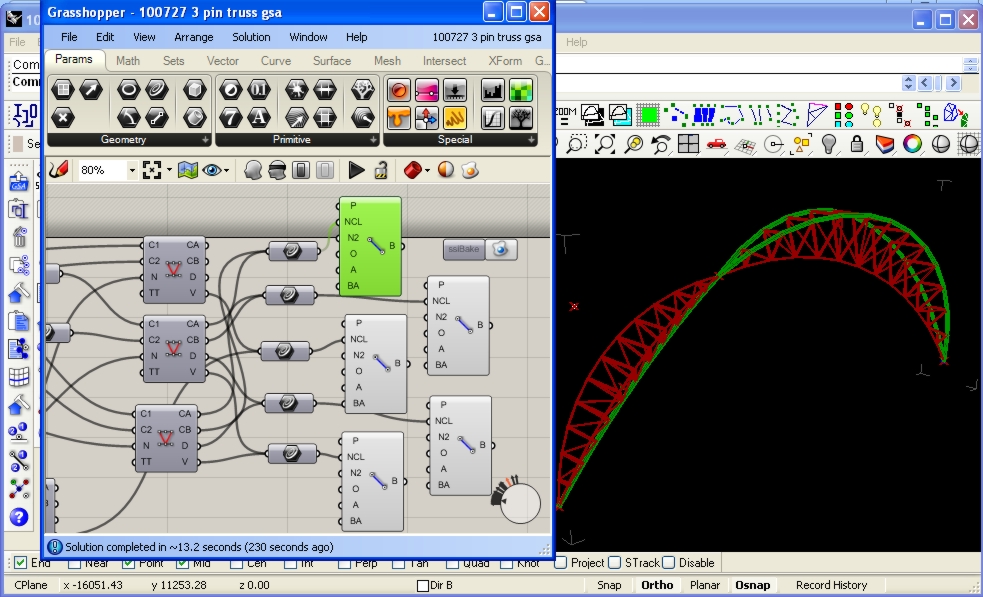
The Rhino/Grasshopper plug-in generating and exchanging data with SAP2000 has been upgraded and now includes the option to "bake" the data directly from Grasshopper to SAP using the OAPI COM interface. No longer needed to save and import a text data file.

If you rebake variations, you might observe historic nodes being left in the model, I am still awaiting advice from CSI on an issue with deleting unattached points. There's more improvements that will quickly be implemented, if you've ideas or suggestions, please send them through.


You can download the 3 pin truss models : Rhino and Grasshoper
The basic mesh and restraint model:  Grasshopper

Thursday, 5 August 2010

Three pin Truss

An assignment was set recently at UC Berkeley to model a three pin truss utilized at the previous Eurostar Terminal at Waterloo, London.


A question on how to generate this arrangement was posted on the Grasshopper forum, and I think it is a fantastic example of structure that should be modelled in Grasshopper to achieve the best design possible.

The assignment due date has passed (I hope), so I think it's safe to post how I would use the Geometry Gym plug-ins to model this structure.  This includes a new BullAnt Truss component, that allows you to select the nature of the truss connectivity (at present, Pratt, Warren, Vierendeel and Brown) between two chord curves.  Other truss types are available upon request.

GSA screen Capture

Download AVI from here

Robot screen Capture


Download AVI from here

And the files so you can try for yourself:

Rhino Model (Required for all Grasshopper Definitions)

Grasshopper definition for BullAnt
Grasshopper definition for Oasys GSA
Grasshopper definition for Autodesk Robot
Grasshopper definition for SAP
Grasshopper definition for SDNF (Steel detailing neutral format can be exchanged to BIM software such as Tekla and Digital Project)
Grasshopper definition for Strand7/Straus7
Grasshopper definition for Sofistik

Other software models coming soon, please request to accelerate.

Friday, 16 April 2010

Parametric Structure Models in Grasshopper

The first Geometry Gym plug-in for Grasshopper with Structural model Interaction has just been uploaded.
http:\\www.geometrygym.com/downloads  Versions for GSA, Strand7/Straus7 and Sofistik are available, other modelling interaction will soon follow (ie  SAP, SDNF, Robot etc).  If you want to influence the priority list for release, send me an email with which version you'd like to use.

So, here's a screen capture demonstrating the use of the plug-in, and sending the parametric model out of Rhino into GSA (similar for Strand7, Sofistik and others).


And to try this for yourself, here's the sample models shown and a revisit of the Gherkin.

First Grasshopper Definition to generate structural beams :          GSA Robot SAP2000 Sofistik Strand7


A simplified version of Newcastle Millennium bridge.  I haven't had a chance to add a slider to rotate it yet :-(

Associated Rhino model with properties :  GatesHead Rhino Model
Grasshoppper Definition : GSA Robot SAP2000 Sofistik  Strand7


Revisiting the mini-Gherkin.  Note I'm sure if I get a chance to study Grasshopper Trees and Branches this definition could be simplified a bit.

Associated Rhino model with properties :  Gherkin Rhino Model
Grasshopper Definition : GSA Robot SAP2000 Sofistik Strand7


Wednesday, 23 December 2009

Orienting Structure to Rhino Surfaces

Here's an example/tutorial for you to follow to use the plug-in to calculate member orientation angles based on the defining surface normal or nearest point.


To try this yourself, here is the Rhino file: Rhino Ellipse


Now the same basic procedure will work presently with 3 analysis packages, GSA, Sofistik (shown) and SAP2000. Strand7 and others coming shortly.
Here's the analysis models:
GSA
Sofistik (Note LOCA 0 is assumed for the moment.)
SAP2000

More instructions coming soon....