Showing posts with label GSA. Show all posts

Thursday, 14 April 2016

Shape to Fabrication 2016

Shape to Fabrication 2016 is on next week, and I'm really excited about returning to London to attend and present at this event.  There's an amazing line up of speakers and the opportunity to speak with the McNeel staff attending makes this an event not to be missed.  Thanks to Simply Rhino for all the effort to organize this.

It's 7 years ago that I last attended Shape To Fabrication, number 3 at Metropolitan Works in 2009.  I'd been promoting and publicly releasing the Rhino plugin online that I'd been working on in house at Expedition,  known as  SSI (Smart Structural Interpreter Connector to GSA).  Bob McNeel suggested pretty close to the event that I should present them at Shape to Fabrication.

Fred Labbe (my colleague at Expedition) was already a confirmed speaker on the Santa Maria del Pianto Metro canopy, and at late notice he was generous enough to let me share the speaking slot to present the rhino plugins.

This event quickly increased awareness, triggered a launching pad for Geometry Gym as a business.    A meeting for clients with McNeel staff (including Carlos Perez and David Rutten) was arranged soon after by RhinoForYou and soon afterwards I had my first paying client and left Expedition to start full time on the development and support of the plugins.

If you'd like to see what I presented, it was posted to youTube (but with no commentary).  The tools have come a long way and it's great to have the chance to get back to this fantastic event.

Tuesday, 16 December 2014

The Poppy - Shrine of Remembrance Melbourne

Here's a stunning success of the Grasshopper to Analysis/BIM workflows with the assistance of the Geometry Gym tools.

John Noel of Irwin Consult in Melbourne emailed me earlier today with some images of a stunning feature recently added to the Melbourne Shrine of Remembrance.

Here's some images by John Gollings which are featured on the Irwin website and this article.
http://architectureau.com/articles/shrine-of-remembrance/


I look forward to visiting this in my pending return to Victoria.  You can read more about the details of this project at the  ARM Architecture website and Irwin Consult website.  Grasshopper, GSA and Revit were involved in the design and documentation of this stunning feature.


Congratulations to all involved.  If you've work that's published/built and it involved the Geometry Gym tools, please let me know and I will be glad to promote it on the blog.

Thursday, 13 November 2014

Karamba to GSA and Robot

I've advanced on the first version of the Karamba exporter, and been testing it with Oasys GSA and Autodesk Robot (which were the most popular early requests).  If you'd like to test this with other software, let me know.

Here's an explanation and demonstration.


And here's some Karamba files to test it on.

Truss

ShellAndBeam

SuspensionBridge


I'm still to implement releases and other attributes, but if you need them please let me know and I'll prioritize the development of them.

Tuesday, 11 November 2014

Karamba Exporter to GSA, Robot, SAP2000, Sofistik etc

I'm seeking out Karamba users (and potential users) for a new workflow for this grasshopper plugin.  For anyone that doesn't know Karamba, it's a structural analysis plugin for Grasshopper.  GeometryGym has developed various plugins to allow generation of structural analysis data within Grasshopper, but then has the overhead of having to export the data out of Grasshopper to the external software, and then import back the results.

Karamba works as a solver entirely within Grasshopper, and should perform faster as a result.  But more traditional software has advantages of being proven and trusted, and often project requirements mandate particular software or certifications for detailed design.  At present, many users are generating the Karamba model for preliminary design, but then rebuilding the model using Geometry Gym equivalent components to export the model out for refined analysis or advanced assessment.

I've been discussing with the Karamba developer Clemens (and advancing on) a utility to extract the Karamba Structural Analysis model so that it could be verified or advanced in alternative commercial structural analysis software.  I know that Karamba can presently export to RSTAB, but I'm working on enabling this further for a wider range of software.  The exporter for Karamba would save users on generating, maintaining and coordinating multiple components if desired to use the data downstream.
At least initially the primary options are the software that I have developed plugins for.  This includes Oasys GSA, Autodesk Robot, SAP2000, Sofistik, Spacegass, Strand7/Straus7 and hopefully shortly SCIA.  The way this exporter would work also means that any structural analysis software recognizing the structural analysis aspects of IFC could also be utilized.

This would permit verification of the model results, and often projects have mandates on using specific (often certified) software for detailed design calculations.
If you're interested in participating in the early testing and advancing of this feature, please get in touch.

Also refer to this forum post for discussion and details.

Thanks,
Jon

Sunday, 9 February 2014

BIMDayOut IFC4: The Shape of Things to Come


The BIM Day Out in Perth last year was a fantastic event, attracting presenters and attendees of a wide spectrum within the AEC industry.

Having been caught in the rain and cold (not really expected in Perth) earlier that week, my voice nearly disappeared (apologies, but the audio captured isn't too bad).


The presentation above primarily demonstrates the utilization of OpenBIM IFC to turn Grasshopper into BIM authoring software (and then receiving and utilizing the models in other software such as Revit or Tekla).

It aims to motivate software users (of all BIM enabled software) to demand more of the IFC implementation of their software, and hopefully shows a capability of IFC to convey intelligent models capable to use downstream in other software.


Congratulations and thanks to BIM Day Out committee for their work in arranging BIM Day Out, looking forward to many more of these events in the near future.

Sunday, 11 August 2013

Oasys Webinar - Linking GSA With Rhino and Grasshopper

Thanks to Oasys for the invitation to help present a webinar on COM execution of GSA and how I've applied this to develop the Grasshopper/Rhino to GSA interactions.

Here's the recording in case you missed it.  If you'd like to see a follow up with explanation of more detailed models, get in touch with myself or Oasys.


Here's the GH definition.  I realized that setting orientation to a point is pretty simple in GSA, setting it to the normal of a defining surface isn't so easy so I've modified for this.  I also made the points internal to the gh definition (rather than linking to a rhino document).

Wednesday, 30 November 2011

Nurbs To Structural Analysis Profile

At the request of the user, I've advanced the routines to convert arbitrary profiles (including nurbs perimeters) into the structural analysis section profiles capable of approximating this shape.

I've started with GSA, and will look into the other software equivalents shortly.  In GSA the perimeter is defined as a polyline (I have enabled an input to define acceptable deviation from original curve), and properties such as area and inertia are computed from the polyline bounds.


The torsion property is not calculated, so I also enabled a section property modifier component to allow user specification of this value (as well as the others).  There is a means to compute the torsional stiffness using soap film (which was the original reason I started coding mesh inflation), and I'll try to test this approach soon.  If you have any papers or technical explanations/demonstrations of this technique, it can only help accelerate this if you can share it.  Grasshopper definition can be accessed from here.

Wednesday, 23 November 2011

Tributary Areas and Variable Loading

I've finally got some final improvements made to some useful functionality that can save hours of spreadsheet processing (or the like thereof).
I've enabled functionality within Grasshopper to compute tributary areas for nodes contained within a structural grid, as well as generating node loads from varying loading phenomena such as snow drifting or wind pressure.

This algorithm was used (in a more time consuming and specific way) for the 2012 velodrome roof in applying wind pressures from wind tunnel testing advice.  At the time we were still optimizing cable spacing but still wishing to test multiple loading scenarios.  This routine can work out tributary areas for arbitrary grids (based on mid distance from adjacent nodes), grid normals (although load can be applied in a uniform direction if desired) and utilize a varying loading intensity at different locations.  This can be defined (or checked) intuitively from a surface (or polysurface) relative to a reference plane (the local z from datum defines the magnitude of loading pressure).

If you download the models below, you'll see it uses a reference plane from the structure (required for non-planar grids), and the relative position from the loading plane.  I haven't yet developed grasshopper visualization of the generated node loads (it's on my todo list along with boundary conditions, releases etc) so you'll have to visualize in the analysis software.  I also plan to implement face loading for finite elements in a similar manner, and any other suggestions that might arise from users, so don't hesitate to send them through.

Please check the results carefully, I hope you find it useful.  I'm also very happy to assist in applying or testing this with your own applications to projects.
GSA model,  SAP model (others to be added shortly).

Tuesday, 8 November 2011

Grasshopper Mesh to Finite Elements

The ability to convert Mesh from Grasshopper (it could have been generated or imported into Rhino) into finite elements with ability to triangulate quad faces failing shape checks has been in the Geometry Gym plugin for some time.  Recent requests from users recently enabled for the GSA plugin have included orthotropic material generation, nomination of finite element shape acceptance criteria (warning, severe warning, all) and ability to nominate varying orientation and property assignments throughout extent of mesh.  Update from http://www.geometrygym.com/downloads and study this file for GSA, and this file for SAP.


Monday, 6 June 2011

Grasshopper GSA Form Finding Examples

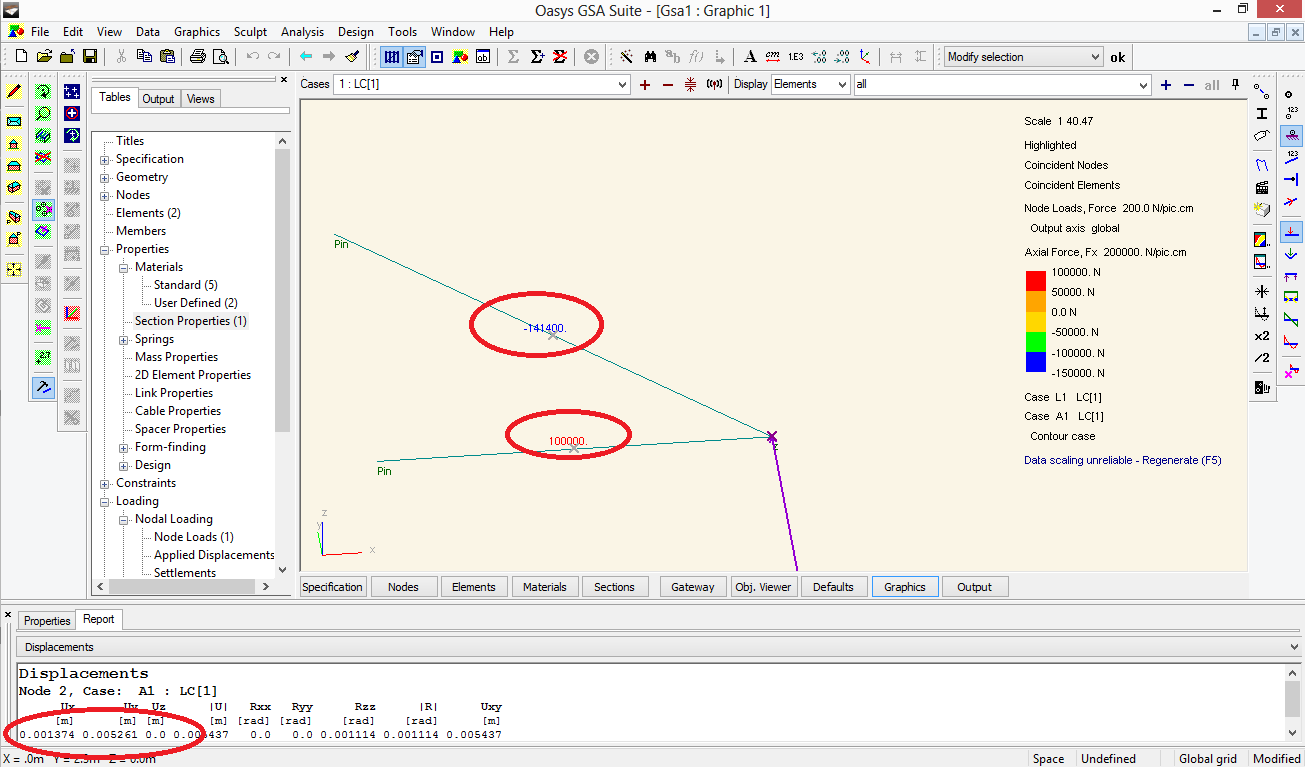
I sat in on the recent Oasys GSA webinar on form finding conducted by Pete Debney, for those that missed it, don't despair.  Here's a recording of it:


I think it's a great resource and introduction/explanation of some of the form finding options provided by the Oasys GSRelax solver.

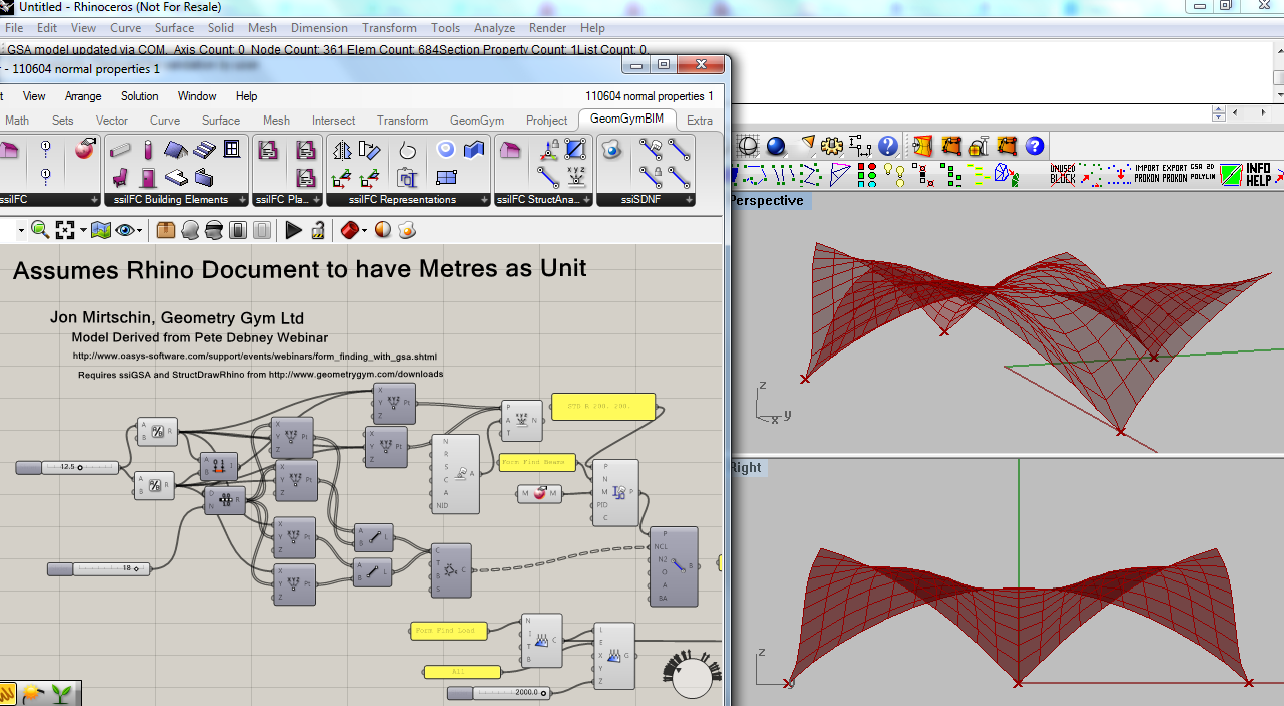
I also think each of the 3 example models are well suited to a parametric exploration using Grasshopper (using the Geoemetry Gym plugin to exchange the model data with GSA), and I'm posting these definitions here so you can try for yourself.

The gsa relax solver is not included in the standard evaluation license, but you can email them and ask for access to it.  I'm still enhancing the plugin in a few areas, you might see toolbars wander if you run GSA as a background service (ie if you don't have GSA running when you open the grasshopper definition, the plugin will start it in the background for you).  If you do have GSA open and Grasshopper appears to "freeze", activate GSA and close any confirmation dialogs that might appear.

Generating the model with geometric shapes using  BullAnt will be enhanced shortly, as well as any user requests so send them through.  Make sure you have latest GSA and BullAnt plugins from here: http://www.geometrygym.com/downloads and the definitions are derived on the basis of a rhino document being open with metre units.


Force Density form finding of a cablenet bridge.  Grasshopper Definition


Compression Shell form finding using Analysis properties.  Grasshopper Definition


Soap Film form finding of tensile membrane with back stay  Grasshopper Definition

Tuesday, 3 May 2011

Grasshopper - Solver Results

I've been progressing components for accessing Structural Analysis solver results recently, primarily for Oasys Gsa and others will shortly follow.  I'm also in early phases of testing a structural analysis solver directly within a Grasshopper plugin (to analyze linear static frames directly and extract results, which should be quicker than sending data to external programs).

I've enabled a Grasshopper component for my vector field to streamlines algorithm, also the work of SPM is looking encouraging in this area.


If you don't have Oasys GSA, you can try this definition (I've baked some principal stress lines into the Rhino document) or you can test the result extraction from GSA using this definition.  Both need this Rhino document with basis mesh.


Also, here's a definition demonstrating generation of false color mesh for Von Mises Stress.

I've also enabled some new features for form finding directly from within Grasshopper using the GSA fablon solver, here's a nice example from a user request outlined here.  Grasshopper Definition


I look forward to hearing suggestions and questions from users.

Thursday, 31 March 2011

GH GSA Form Finding Tensegrity

A first study of tensegrity form finding using GSA, I plan to add to this post some models of some nice towers.


Here's a start to that, note I'm looking to adjust the component calculation order as the solver needs to be computed only after all other components have calculated.  If you have problems of only partial model update, try deleting and adding a new solver component (or disabling, recomputing, and enabling).

Model Files to try yourself.

Wednesday, 23 March 2011

Galapagos and GSA solver

It's still early stages of testing and development of some recent work I've been doing to enable access to GSA solver directly within Grasshopper (and importantly Galapagas).


The attached example is still primitive, I'll find a moment to extend it to include a stiffness per mass objective, but it does demonstrate a few aspects of using this technique.

All feedback appreciated, including requests for more components to save manual generation of GWA attributes (which is shown for the point load generation).

Grasshopper Definitions
GSA    SAP    SpaceGASS    Egret    Robot

Monday, 21 March 2011

Grasshopper-GSA Form Finding and Structural Analysis


Some really exciting new features to be activated in the next public build of the Rhino/Grasshopper plugin connecting to Oasys GSA that will allow generation of a complete Structural Analysis model within Grasshopper including loads, materials, analysis tasks and solver controls.  This will allow form finding of membrane and tensegrity structures incorporating advanced structural attributes including loads, with realistic materials.

This will not be real time "dynamic" response such as kangaroo physics plugin (which at present can not perform at real time speeds with realistic materials and stiffness).

Interrogating and utilizing analysis results will also be enabled, including more conventional models and frames.

If you have requests/suggestions for this release don't hesitate to get in touch.  Other popular solvers including SAP2000, Robot and Strand7 are expected to follow in the near future.

I'll shortly be posting more detailed instructions, but for the time being you can download the grasshopper definition from here : Grasshopper Definition  You'll need latest Plugin for GSA from http://www.geometrygym.com/downloads

Tuesday, 22 February 2011

GH to GSA Finite Elements from Area and Regions


A feature that I added earlier this year was the ability to generate Structural Areas and Regions for Oasys GSA from Grasshopper.  You then mesh the structural areas within GSA.

Here's the associated models to try yourself.

Rhino model  Grasshopper Definition

Thursday, 5 August 2010

Three pin Truss

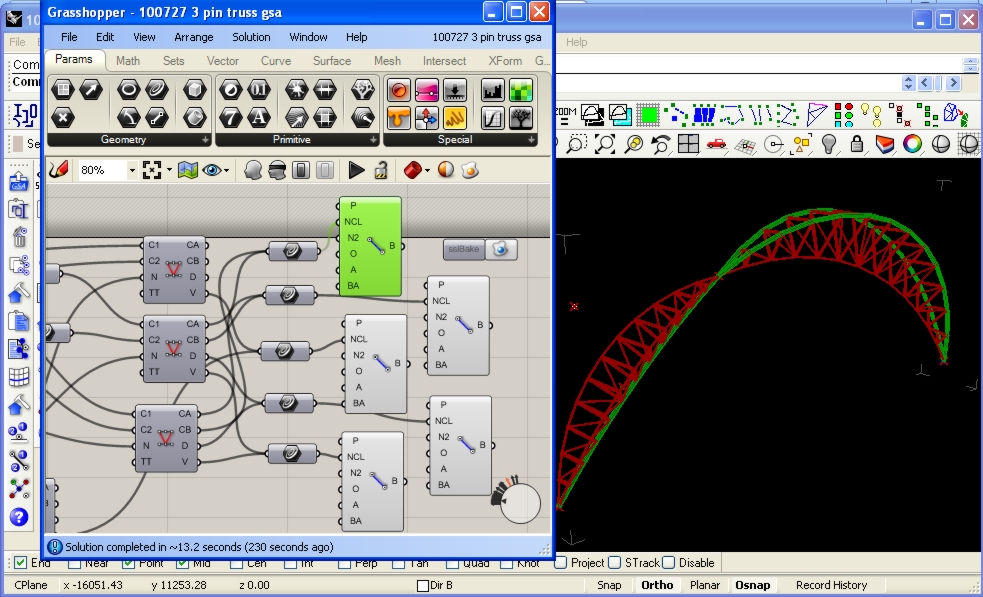
An assignment was set recently at UC Berkeley to model a three pin truss utilized at the previous Eurostar Terminal at Waterloo, London.


A question on how to generate this arrangement was posted on the Grasshopper forum, and I think it is a fantastic example of structure that should be modelled in Grasshopper to achieve the best design possible.

The assignment due date has passed (I hope), so I think it's safe to post how I would use the Geometry Gym plug-ins to model this structure.  This includes a new BullAnt Truss component, that allows you to select the nature of the truss connectivity (at present, Pratt, Warren, Vierendeel and Brown) between two chord curves.  Other truss types are available upon request.

GSA screen Capture

Download AVI from here

Robot screen Capture


Download AVI from here

And the files so you can try for yourself:

Rhino Model (Required for all Grasshopper Definitions)

Grasshopper definition for BullAnt
Grasshopper definition for Oasys GSA
Grasshopper definition for Autodesk Robot
Grasshopper definition for SAP
Grasshopper definition for SDNF (Steel detailing neutral format can be exchanged to BIM software such as Tekla and Digital Project)
Grasshopper definition for Strand7/Straus7
Grasshopper definition for Sofistik

Other software models coming soon, please request to accelerate.

Thursday, 29 July 2010

Generate Finite Element model in Rhino and exporting back Stress Results


I've had a number of requests lately about analyzing Rhino/Grasshopper mesh and using the mesh results back in Rhino/Grasshopper.  Thanks to Tom of [UTO] for this particular example, which was mesh created in Grasshopper using WeaverBird.

The video above demonstrates this using GSA (which is free for Students).
The rhinocommand ssiGSAMeshtoGWA translates a Rhino mesh into GWA data which can be pasted in the gateway. The mesh remains unchanged, although the routine will triangulate quad faces that are not within GSA planar tolerance.

Node Restraints, finite element properties and loads are quickly applied in GSA, and the model analayzed for results. The results can be exported to a text file, which can then be loaded back into Rhino. The number and nature of these results can be controlled in the GSA export process, and this can be saved into the GSA model as saved output to be recalled later. ssiGSALoadResults command can be used to open this results file and false-colour the mesh. Note the model data must be active in either the Rhino (or Grasshopper) plug-in (thus I imported the model data back).


There's improvements to be implemented in the near future, including other results and importing into a Grasshopper component.

Here's the files so you can try for yourself:
Rhino Mesh Model
GSA Model


19th August 2010
Some further discussions and experiments with finding vector fields on the Grasshopper forum  for the model have prompted me to append this blog post.


I've added some additional functionality to ssiRhinoGSA (v0.8.0037 and newer) to allow using the command ssiGSALoadResults command to interpret Principal stress data results.  An export such as this results.txt
can be read, I used a scale factor of 2e-8 and unsigned magnitude to generate the lines representing the principal stress vector field.  You can then set these lines in Grasshopper and convert to vectors as shown in this Grasshopper model.

Friday, 16 April 2010

Parametric Structure Models in Grasshopper

The first Geometry Gym plug-in for Grasshopper with Structural model Interaction has just been uploaded.
http:\\www.geometrygym.com/downloads  Versions for GSA, Strand7/Straus7 and Sofistik are available, other modelling interaction will soon follow (ie  SAP, SDNF, Robot etc).  If you want to influence the priority list for release, send me an email with which version you'd like to use.

So, here's a screen capture demonstrating the use of the plug-in, and sending the parametric model out of Rhino into GSA (similar for Strand7, Sofistik and others).


And to try this for yourself, here's the sample models shown and a revisit of the Gherkin.

First Grasshopper Definition to generate structural beams :          GSA Robot SAP2000 Sofistik Strand7


A simplified version of Newcastle Millennium bridge.  I haven't had a chance to add a slider to rotate it yet :-(

Associated Rhino model with properties :  GatesHead Rhino Model
Grasshoppper Definition : GSA Robot SAP2000 Sofistik  Strand7


Revisiting the mini-Gherkin.  Note I'm sure if I get a chance to study Grasshopper Trees and Branches this definition could be simplified a bit.

Associated Rhino model with properties :  Gherkin Rhino Model
Grasshopper Definition : GSA Robot SAP2000 Sofistik Strand7


Monday, 4 January 2010

Structure Analysis Model from Curves


Try for yourself the routines to generate structure analysis model from curves and points in Rhino.
Rhino Model from here.

Wednesday, 23 December 2009

Orienting Structure to Rhino Surfaces

Here's an example/tutorial for you to follow to use the plug-in to calculate member orientation angles based on the defining surface normal or nearest point.


To try this yourself, here is the Rhino file: Rhino Ellipse


Now the same basic procedure will work presently with 3 analysis packages, GSA, Sofistik (shown) and SAP2000. Strand7 and others coming shortly.
Here's the analysis models:
GSA
Sofistik (Note LOCA 0 is assumed for the moment.)
SAP2000

More instructions coming soon....