Showing posts with label Form Finding. Show all posts

Monday, 6 June 2011

Grasshopper GSA Form Finding Examples

I sat in on the recent Oasys GSA webinar on form finding conducted by Pete Debney, for those that missed it, don't despair.  Here's a recording of it:


I think it's a great resource and introduction/explanation of some of the form finding options provided by the Oasys GSRelax solver.

I also think each of the 3 example models are well suited to a parametric exploration using Grasshopper (using the Geoemetry Gym plugin to exchange the model data with GSA), and I'm posting these definitions here so you can try for yourself.

The gsa relax solver is not included in the standard evaluation license, but you can email them and ask for access to it.  I'm still enhancing the plugin in a few areas, you might see toolbars wander if you run GSA as a background service (ie if you don't have GSA running when you open the grasshopper definition, the plugin will start it in the background for you).  If you do have GSA open and Grasshopper appears to "freeze", activate GSA and close any confirmation dialogs that might appear.

Generating the model with geometric shapes using  BullAnt will be enhanced shortly, as well as any user requests so send them through.  Make sure you have latest GSA and BullAnt plugins from here: http://www.geometrygym.com/downloads and the definitions are derived on the basis of a rhino document being open with metre units.


Force Density form finding of a cablenet bridge.  Grasshopper Definition
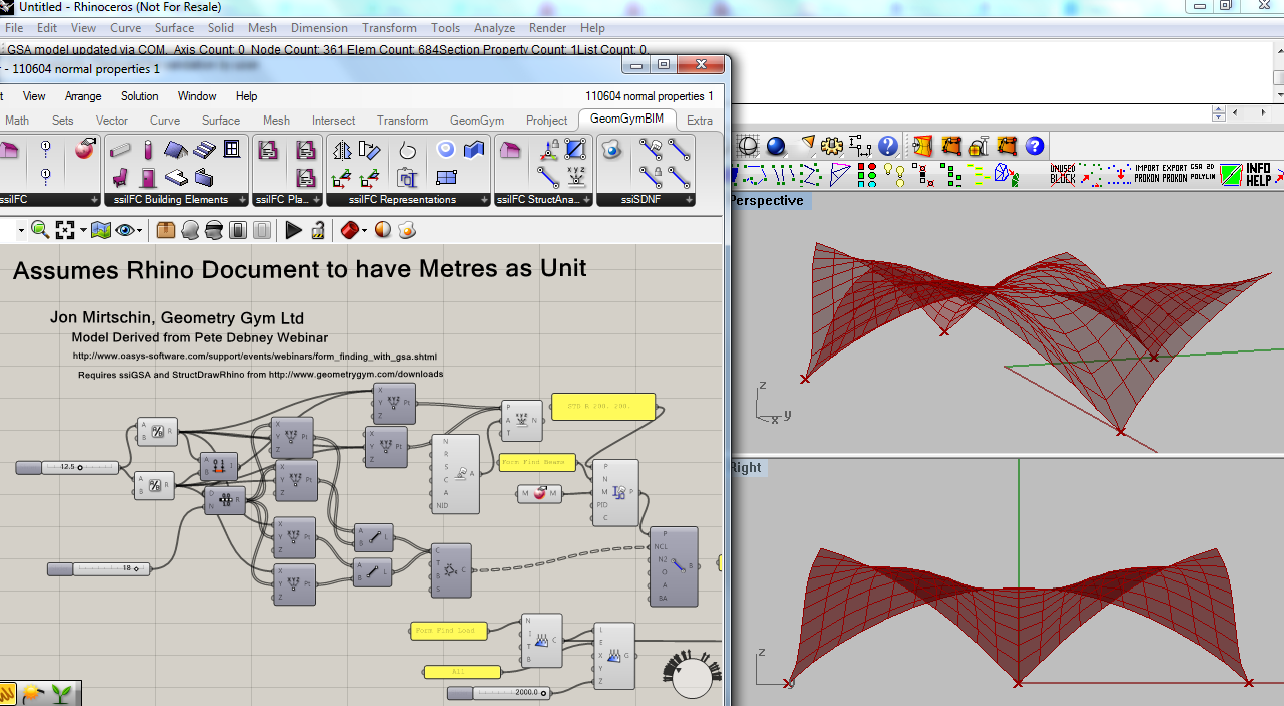


Compression Shell form finding using Analysis properties.  Grasshopper Definition


Soap Film form finding of tensile membrane with back stay  Grasshopper Definition

Tuesday, 3 May 2011

Grasshopper - Solver Results

I've been progressing components for accessing Structural Analysis solver results recently, primarily for Oasys Gsa and others will shortly follow.  I'm also in early phases of testing a structural analysis solver directly within a Grasshopper plugin (to analyze linear static frames directly and extract results, which should be quicker than sending data to external programs).

I've enabled a Grasshopper component for my vector field to streamlines algorithm, also the work of SPM is looking encouraging in this area.


If you don't have Oasys GSA, you can try this definition (I've baked some principal stress lines into the Rhino document) or you can test the result extraction from GSA using this definition.  Both need this Rhino document with basis mesh.


Also, here's a definition demonstrating generation of false color mesh for Von Mises Stress.

I've also enabled some new features for form finding directly from within Grasshopper using the GSA fablon solver, here's a nice example from a user request outlined here.  Grasshopper Definition


I look forward to hearing suggestions and questions from users.

Thursday, 31 March 2011

GH GSA Form Finding Tensegrity

A first study of tensegrity form finding using GSA, I plan to add to this post some models of some nice towers.


Here's a start to that, note I'm looking to adjust the component calculation order as the solver needs to be computed only after all other components have calculated.  If you have problems of only partial model update, try deleting and adding a new solver component (or disabling, recomputing, and enabling).

Model Files to try yourself.

Monday, 21 March 2011

Grasshopper-GSA Form Finding and Structural Analysis


Some really exciting new features to be activated in the next public build of the Rhino/Grasshopper plugin connecting to Oasys GSA that will allow generation of a complete Structural Analysis model within Grasshopper including loads, materials, analysis tasks and solver controls.  This will allow form finding of membrane and tensegrity structures incorporating advanced structural attributes including loads, with realistic materials.

This will not be real time "dynamic" response such as kangaroo physics plugin (which at present can not perform at real time speeds with realistic materials and stiffness).

Interrogating and utilizing analysis results will also be enabled, including more conventional models and frames.

If you have requests/suggestions for this release don't hesitate to get in touch.  Other popular solvers including SAP2000, Robot and Strand7 are expected to follow in the near future.

I'll shortly be posting more detailed instructions, but for the time being you can download the grasshopper definition from here : Grasshopper Definition  You'll need latest Plugin for GSA from http://www.geometrygym.com/downloads

Thursday, 25 March 2010

Force Density Relaxing Roofs

Arthur Mamou-Mani posted on the Grasshopper forum (http://www.grasshopper3d.com/forum/topics/tensile-membrane?commentId=2985220:Comment:54158 ) about tensile membranes and Rhino plug-ins that can compute shapes and forms.

I thought the problem looked interesting, and thought I'd see what I could achieve with the new mesh minimal surface tools I've been improving in StructDrawRhino.

You need the latest version of BullAnt (http://www.geometrygym.com/downloads ) and a license file, but you can try this for yourself.
Note, if you altering the inputs such as the control curves, I'd recommend disabling the Grasshopper meshing component temporarily, and then reconnecting it when you want to recompute.

Rhino Model
Grasshopper Definition             

What you find in the basic definition, is that the isolated mesh restraint points produce a very pointed roof, in reality we wish to strength the links along the ridge line.

Here's a revised definition that produces a more desirable result
Strengthened Ridge Line Grasshopper Definition 

Note that the image shows the mesh baked, which helps identify the isocurves or underlying mesh.  Toggling the preview update input can give some insight into how the algorithm is working, at the expense of a slower result.

Sunday, 21 March 2010

Costa Minimal Surface

Force Density (Using the Mesh Vertex Repel command)


Grasshopper Definition     

This definition calls on the ggForceDensity Relax functionality to compute a minimal surface discovered by Costa.  This command doesn't compute minimal surfaces for all mesh, but at least seems to give a reasonable impression for Costa Minimal Surface.

Here's a generic model to also test it.

Grasshopper Definition     

Note, that unless you have a quick computer (or a lot of patience), it's probably worth disconnecting at the Mesh component (or disabling) and previewing the surface if you wish to adjust the sliders for variations.

Arc Poly Curve Extrusion boundary Minimal Surface

Grasshopper Definition

There is also capability to restrain mesh vertex to nominated points, curves and surfaces.  Some examples demonstrating this will be posted soon.